Instruments and studio
The gear behind the sound.
Explore the guitars, custom modifications, recording equipment, and practical choices that shape Andrew Otwell’s music.
Electric Guitars
I have played hundreds of guitars and enjoy building my own or customizing all my guitars built by others (ex. Gibson Les Pauls). The standard adjustments I make are on the fret ends/edges by smoothing them out so they don't cut into my left hand index finger. Sometimes I also have to level and polish the frets (tops) but usually don't have to go to that degree on new Les Pauls and this custom built Explorer style guitar. Other standard adjustments are to the pickups, usually involves swapping them out completely, and sometimes disassembling the pickups and pulling coil windings.
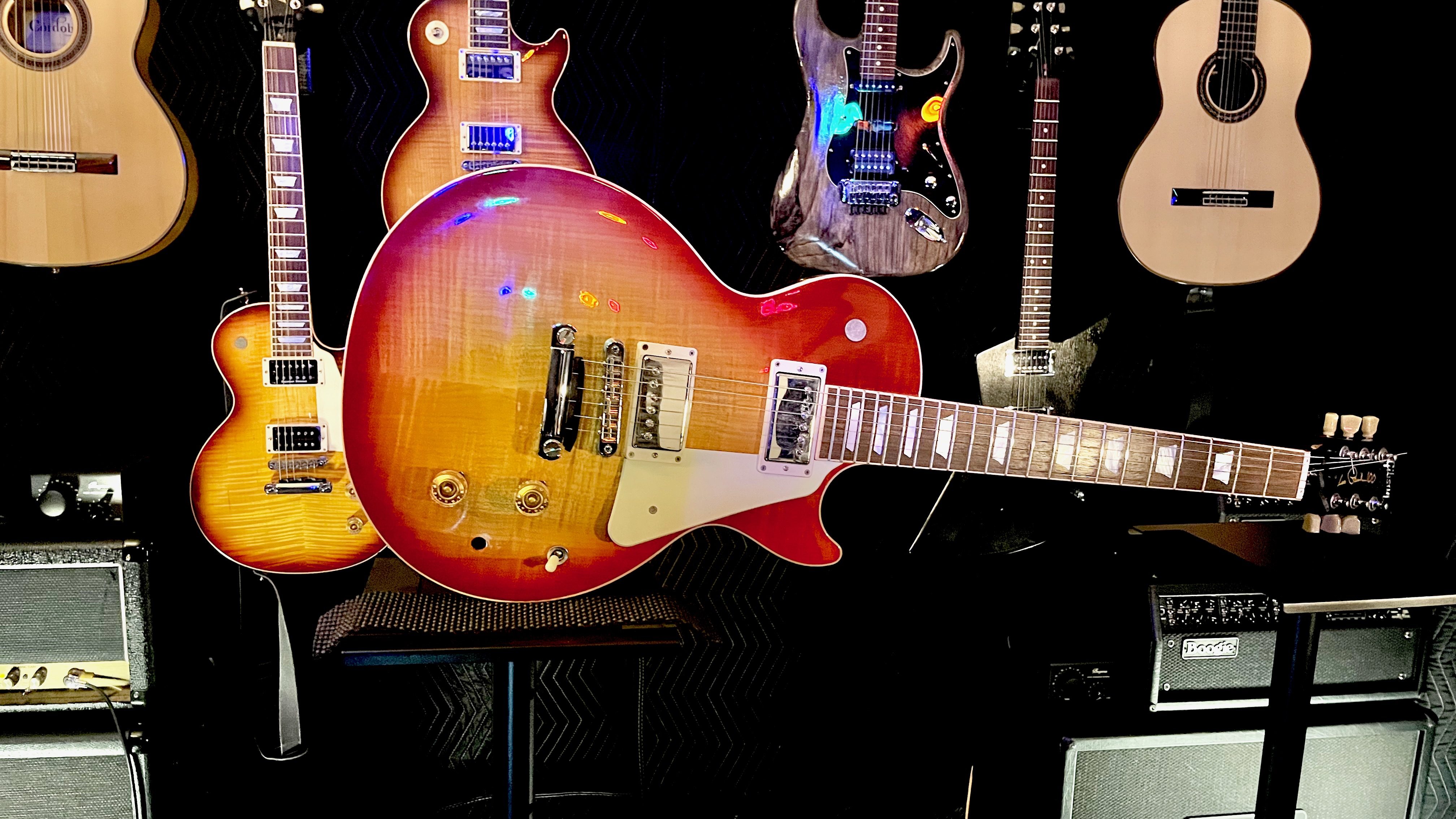
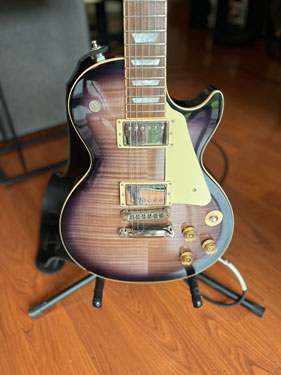
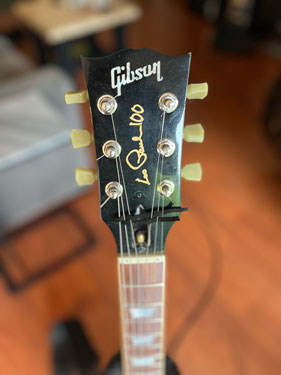
After three decades of playing double cutaway instruments, I finally played a REAL Gibson Les Paul in 2015. In fact, they were a pair of Gibson 2015 Les Paul Traditionals. I really liked the tone, feel, and balance of the instruments. I also liked the full weight and extra features of the modern Traditional (ex. wide neck). I ended up customizing them extensively by replacing the G-force tuning system with Grover 135N Vintage Tuners, replaced pickups, changed wiring and switch locations, knobs, and the strap locations. These pictures are of the original pair plus the more rare edition of the Placid Purple.


Classical Guitar Rig
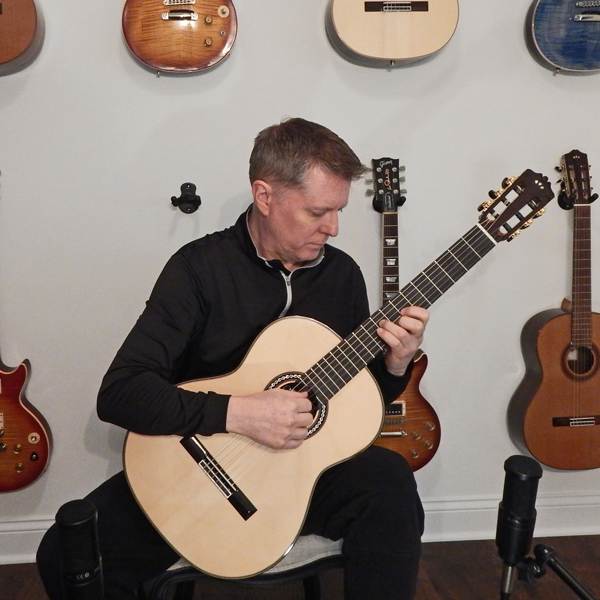
With Classical Guitar, I prefer an unobstructed tone which means I don't care for add-on piezo electronics or contact with the body top. I use two microphones placed on either side in front of me with panning set for full left and full right. I really prefer to record wearing full sized headphones so I can hear precisely what the microphones and mixing board are picking up. That does not work well for video recording so for videos I just listen naturally to the instrument and room.
Composition and Recording Equipment
For composition, I use my personal knowledge base comprised of all the lessons learned over the years. Lately, I have been horrified to see notation software vendors building "instant orchestra" features. I understand the value of Artificial Intelligence (AI) but when it comes to composing music, I prefer the conscious human mind. For composition data entry, I used MakeMusic Finale for over 10 years in simple entry mode (and thousands of mouse and keyboard clicks) and now switched over to Dorico Pro 5 due to end of life of Finale. For recording, I have used different methods over the years. Long ago, I used a Fostex tape deck multi-track recorder. Later, I used a Fostex digital VF80 8 -track recorder. I have also used a laptop and Tascam DR-1 (line in, mid-gain, limit on). Around 2013, I finally entered the realm of DAW with REAPER for professional quality sound production. Their small business discount helped me greatly. To this day, three albums later, and several recorded videos for YouTube, I am still using REAPER.
I have my rig setup with two audio systems. Audio system #1 is connected directly to my laptop audio output which is the main (REAPER) mix. I use Audio system #2 for my guitar signal. The signal runs through all my floor components, then the rack components and then through a Mackie ProFX24 mixer which is USB connected to the laptop (audio interface). To avoid the incredibly irritating audio delay (referred to as latency), I only monitor the live guitar signal through the audio system #2 rather than monitor the guitar signal going into the DAW on audio system #1. When I record, I am listening to both audio systems (#1 and #2) playing simultaneously but I have the guitar signal set to monitor off in REAPER.
My detailed signal path looks like:
- Guitar
- Pedals with Stereo Signal output
- Amplifiers with full speaker cabinets mic'd with SM57s or H&K RedBoxes for DI
- Rack with Compression and Noise Gates (Optional) and Studio effects (FX)
- Mixing Board with USB into DAW w/ stereo inputs 1/2 (not using the 3/4 method)
- Audio System with Apple Studio Monitor speakers or external Flat Response Studio Monitors
- Sometimes I use external headphones off the DAW so I do not get room mic bleed over into the mix
Initial Signal Processing
This is my 2024 pedal board setup which includes a highly modified CryBaby wah pedal and stereo outputs. Shown also is my rack which runs stereo signals into my mixing board and external speaker cabinets running Celestion G12H-75 creambacks (British) and Celestion Vintage 30s (British).
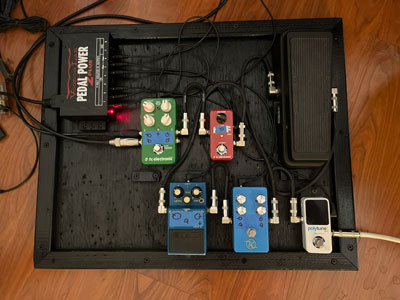
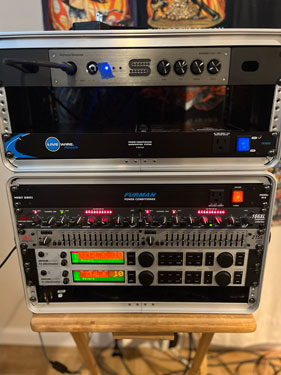
Below is the setup I used for my second studio album, released 2015. This snapshot also includes a Morley Wah and modded Tube Screamer.

For the first studio album, released in 2014, I used a VOX ToneLab EX (with 12AX7 tube) and using a Rocktron MIDI controller to control my rack effects (Lexicon). I then ran my signal into a mixing board, the DAW, and external amplifier. This setup provided me fantastic tone quality and kept the noise level down to studio quality. This rig also allowed me to keep my components powered up for days on end without worry of burning out EL34 power tubes.


Pedal Mods
I have modded most of my pedals to suit my needs (thanks to Brian Wampler's, StinkFoot, and other people's articles and videos). I change the LED from 3mm red to 5mm yellow and proceed with cleaning up the circuitry to provide a clear signal. To date, I have modded my CryBaby Wah (made true bypass, eliminated input buffer, and change Wah EQ range), Phaser 90 (reduced feedback loop and shunt highs to ground with capacitor), Boss DS-1 and Ibanez TS9 . I also modified my Marshall DSL100Hs input section, DSL100H footswitch to include status LEDs, and modded my Fender Tube amp input sections. I'm not posting those mods.
Amplification & Signal Processing

For my first three albums, I preferred gritty tones for my guitar signals (both light grit, heavy grit, and everything in between by using my guitar volume/tone controls). I used several pedals in front of the amp; namely compressors, modded Boss DS-1's or BD-2's, modded CryBaby GCB95, and chorus pedal. I like my cleans punchy and my lead tone to be somewhere in the middle between gritty metal rhythm tone and pure bluesy tube screamer style tone. I like the note recognition aspect of overdrive while also maintaining some grit for sustained chord blending and usable harmonics.
These pictures show my Marshall setup which includes my modified Marshall DSL100H . The stock head was way too nasally sounding so I couldn't help but crack it open and modify the input components as well as a couple of the green and red channel components. Depending on the size of the venue, I use various Marshall speaker cabinets (MX412A, MX412B, MC212) . I loaded the 4x12" cabinets with Celestion G12M 25w speakers but since I was not playing large, live gigs then I finally sold both of them and now use either 1x12" cabinets or 2x12" cabinets. I also converted my closed-basck cabinets to open back with the opening somewhere between 23-25% of the cabinet back to match the sound of open back Fender amps.
I used to have an impedance selector for 16 ohms or 4 ohms in my MC212 but I have since removed it. Most people won't care but I figured I'd keep the schematic out here if anyone was interested in an electronics project.

During the 2000's I used a Vox AC30VR amplifier. This was the amp I used to record the majority of sound bites which are now fueling the Otwell Music rock albums.

During the late 90's and early 2000's I used a Carvin 100w MTS3200 amplifier and custom pedalboard.


In the early 90's I acquired a preowned ADA tube preamp (with 12AX7 tube) and a Peavey 60/60 tube power amp (with 6L6 tubes). I ran this into my Marshall (4 ohm) cabinet. I wish I still had these components. I probably would have kept this rig if I owned the matching ADA footswitch. It did not come with the purchase and at the time a MIDI controller was just too expensive for my budget. I absolutely loved that setup and wish I still had it to this day.


I originally entered the guitar tube amp market with a Marshall JCM800 series tube head (Artist 3203 - 30w). You could say this head started it all. This hybrid head provided me with great tone and plenty of volume. I also compared mine to someone else's and mine sounded much better. I later determined it was due to a previous owner had the head modified with a variable power tube bias feature. The tube bias mod involves a trim pot in place of R1 on the PCB. Back then, I ran this into a Marshall 1960A speaker cabinet (rewired in series for 4 ohms). I have owned this head for over 30 years now and it is still going strong. Back in March of 2015, I used this head to record several tracks on the second studio album.
